Why are furious mobs in Vietnam murdering the desperate men accused of stealing dogs bound for the dinner table?
1. The Thief
No one knows what time Nguyen Dinh Phong left his low concrete home in Nghe An Province, in the heart of Revolutionary Vietnam. The skinny 27-year-old heroin addict had already stolen everything he could from the people he left sleeping at home—his wife, his kids, his aged parents. So he screwed a fake license plate to his motorbike, grabbed a snare pole, and set off into the damp, bug-addled night to score.
The shops lining the road sold all manner of escape, everything from beer to airline tickets. On the night in question, Phong cared most about the dog restaurants that offered delicious, testosterone-soaked nights off from girlfriends, wives, and mothers. Behind their bamboo curtains, guys like him could spend a night in a haze of rice wine and dark, gamey meat dressed up in fresh herbs, a spicy rhizome called galangal, and deeply-funky fermented shrimp paste.
Tonight, Phong hoped they’d offer a quick $20; all he needed was a dog.
He took a muddy district road through the old communal rice paddies still dotted with ancestral graves and past the new factories bringing low-wage jobs to the people who’d served as communism’s most virulent defenders. Along the way, according to a news report describing the events, Phong allegedly picked up a driver who knew his way around the volunteer roadblocks created to enforce a new curfew and keep people like them away.
About a mile from Phong’s home, they found sleepy Hung Dong Commune in a total blackout.
The driver cut off his dim headlight and let the low growl of his engine wake the dogs. They began to bark and howl, just like clockwork.
Phong stared expectantly into the blackness, and snaked the noose deftly around the first mutt that ran up on them. The bike jolted forward, and Phong felt his quarry’s neck snap as its body dragged along the rough road behind him. He yanked the dog’s corpse up into a rice sack and for a moment it must have seemed they’d gotten away with it.
Suddenly, the men stopped in the road as a group of locals appeared in the distance. The driver bolted, leaving Phong holding the dead dog and his snare. He froze and soon found himself being beaten in the dirt by a furious posse. Thieves had bled them of dogs for months, and he was the first they’d ever caught.

Phong’s mother would later hear that her son’s pleas for mercy woke the whole village. Some witnesses told her they stayed indoors while others—no one ever identified exactly who—wandered out to get their licks in. At one point in the madness, someone rushed forward and jammed a pitchfork into her son’s scrawny torso. Shortly before the sun came up, the mob dragged him toward the concrete People’s Committee Building and tied the half-dead young man to the motorbike he rode in on. As they deliberated about what to do with him, someone doused him in gasoline and dropped a match.
The fumes of his burning clothes mercifully rendered Phong unconscious before reducing him to a few charred remains the flames didn’t want.
Police called his mother the following morning to identify her son’s body.
“Luckily, I recognized his hands and his face,” she told me when we met between the bare cracked walls of her home two years ago. Tet had just passed, but the house lacked even basic signs of celebration, like a pot of flowers or a fruit tree.
The authorities happily handed over Phong’s remains so she could give them a proper burial—one that would convince his spirit not to hang around and haunt the place. When she returned to find out who exactly killed him, the town proved far less helpful.
“They considered him trash,” she said. “There was no pity.”
Phong’s family didn’t fare well without him. His father died soon after he did. Then his wife dumped their kids on his stooped 60-year-old mother and took another husband. The police never arrested anyone for his murder, and his children have gone five years without the meager blood money courts here award to orphans of murder and manslaughter. Perhaps for this reason, Phong’s mother remains the only person I met who expressed any interest in who killed him.
“I want to know,” she said, her rust-colored eyes burning into mine. “Go and ask them.”
Newly deputized, I rolled into the town wondering how to ask a stranger if he’d killed a man.
Hung Dong didn’t look like the sort of place where lynchings happen. In fact, it looked like the kind of place where nothing happens—just another cluster of single-story homes and dusty shop fronts facing a road ground to gravel by trucks hauling everything the people make off to cities and ports.
The veteran at the reception desk of the People’s Committee Building offered a knotted, swollen hand then folded his long, acne-scarred face into a smile that would reveal nothing. Without an official letter of introduction from my newspaper and the Ministry of Foreign Affairs, he could only discuss the lynching of dog thieves unofficially, over rice wine.
“And dog meat?” I asked.
He nodded yes. But today he was too busy. Tomorrow too. And the day after. In an exchange marked by protracted silences, he let me know he’d never be free to speak to me.
At a nearby rice joint, I found a group of men taking post-prandial rips of bitter tobacco from a filthy bamboo bong. The group nodded and laughed when asked if their village beat dog thieves to death. When asked if any among them had participated in such a killing, they all stood up and walked to their motorbikes without answering.
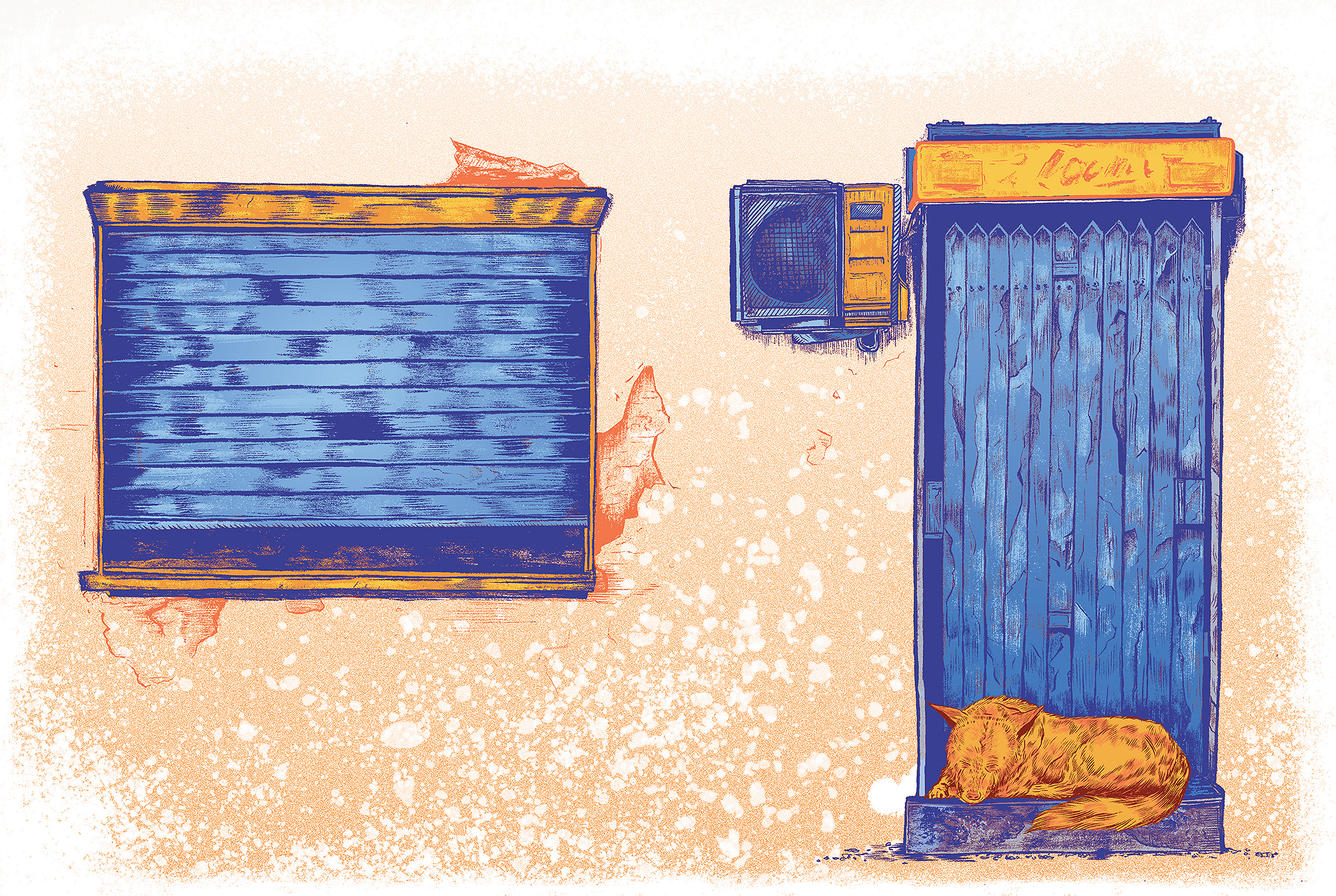
Down the road, in both directions, dogs trotted silently past shuttered dog meat restaurants that had closed until the next full moon. In the meantime, the canine guardians of these restaurants curled up in their doorways, waiting for business to begin.
2. Life, Justice, Meat
I moved to Vietnam in June 2010 to take a job as a sub-editor at a state-owned newspaper. The following month, Phong died, and the garbled brief about his murder left me wondering, generally, about the nature of life, justice, and meat in Vietnam. Those questions grew more pressing as briefs chronicling grizzly, dog-related deaths spread to every corner of the country.
I counted more than 30 bodies in the English-language stories alone. Few people I met seemed troubled by the trend. All the anonymous witnesses and participants ever told reporters was, “Dogs are a part of the house.”
Longer stories came—tear-soaked interviews with bereaved families and breathless tales of thieves who narrowly escaped lynchings. My co-workers dismissed it all as scurrilous and sensational. “That’s just what happens,” one told me, laughing about the whole thing. “The thief gets caught, and so they all want to get their hit in.”
That didn’t seem right, either. Every once in a while, villages would kidnap a policeman to protest the seizure of a cemetery or tear up a factory over China’s incursion into Vietnamese waters. Boys in a northern village once beat up an in-law for wandering into town and chatting up a local girl, and YouTube contains hours of footage of Vietnamese kids getting stomped bloody for trying to steal bicycles or motorbikes. But lynchings weren’t a thing in Vietnam. No village I’d ever heard of conspired to murder a man for burgling a television or karaoke machine.
The line “dogs are part of the house” also didn’t account for why so many people ate them. It didn’t account for how a peaceful community came to snuff out Phong’s life with fire and farm equipment. It didn’t explain what moved people from another nearby village to pour into a road to prevent an ambulance from saving a dying dog thief. It didn’t serve well as the caption to images of charred motorbike frames dangling from telephone poles or horrified, bloodied men kneeling pitifully before crowds, always with the same crude sign hung round their necks—“I am a dog thief.”
The thieves battled the mobs with everything from pepper bombs to the jerry-rigged tasers. Some carried swords. That, in turn, inspired local militias to set up impromptu roadblocks and patrols that created a lot of confusion. Members of at least four of these semi-sanctioned posses ended up in prison for murdering dog thieves both real and imagined. Every once in a while, a tipsy school teacher got the stuffing beaten out of him for getting lost on his way home.
This all felt very remote and removed at the newspaper, where my younger colleagues took pains to denounce dog eating as the stuff of drunk uncles, hayseeds, and—worst of all—Hanoians. When these sophisticates weren’t around, though, drinking buddies whispered invitations to the packed alley full of dog meat restaurants right across the street.
A municipal slaughterhouse inspector I spoke to casually estimated that half the dogs served at those restaurants were stolen from homes. The others, he said while smoking a cigarette in a half-buttoned uniform shirt, were raised by poor families living in outlying settlements that still lacked flushing toilets. His own household, he said, ate dog “almost-never.”
Statements like this quickly became a conundrum. How many people genuinely disliked dog eating and how many thought that’s what foreigners all wanted to hear?
One worldly café owner told me he gave up dog meat because it made him feel bad. “I mean, you’re asking yourself, is this someone’s pet?” he said while we jogged down a major thoroughfare. Dog’s status as a guilty pleasure, he said, renders it a delicacy without a single fancy restaurant. Yeah, I shot back, dog restaurants did all seem sort of seedy and furtive—like adult bookstores or something.
“Right,” he said. “Dog is like porn.”
I knew I’d have to try the stuff one day.
At some point, Western Civilization made an emotional choice to treat dogs like our best friends.
In 1959, the spy and poet Vu Bang claimed that a dinner of dog had the power to shake a broken-hearted man out of a suicidal tailspin. Bang closed his 4,500-word ode to canine feasting with the following sermon:
Oh, you can’t listen to what they say!
Eating dog meat is uncivilized, dirty, inhumane…
And what else? And what else?
People say that the dog is “man’s best friend,” that eating dog is barbaric.
So why do Europeans and Americans eat horses?
They say dogs are filthy scavengers.
What about chickens, pigs and fish—how do they eat?
No. Dogs are animals to be eaten. Eating dogs is no different from eating rabbits, deer or cows. What’s more, they’re delicious and nutritious. So no matter what they say, I still believe it’s a delicacy of the Vietnamese people: “so long as our nation remains, dog meat remains.” The future of our culinary culture depends on the preservation of dog meat.
In his acclaimed War-era novel, The Sympathizer, Nguyen Thanh Viet described how Vietnamese refugees resettling in America struggled with the need to hide all this from their newfound countrymen:
While some of us indeed had been known to sup on the brethren of Rin Tin Tin and Lassie, we did not do so in the Neandrethalesque way imagined by the average American, with a club, a roast, and some salt, but with a gourmand’s depth of ingenuity and creativity, our chefs able to cook canids seven different virility-enhancing ways, from extracting the marrow to grilling and boiling as well as sausage making, stewing and a few varieties of frying and steaming—yum!
Viet’s characters had plenty of reason to keep mum. At some point, Western Civilization made an emotional choice to treat dogs like our best friends and then quickly began to wield that distinction as a kind of cudgel. Bores in this camp believe that everyone should and will treat dogs the same way Americans do, one day. In the meantime, few among them can resist the temptation to visit Vietnam to construct bizarre anthropological theories about people who like the way these animals taste.
In 2013, a vacationing Stanford professor and nationally syndicated columnist named Joel Brinkley put forward a bizarre theory that attributed Vietnam’s geopolitical “aggression” to the nation’s cuisine. He singled out dog meat consumption as “the most gruesome thing I have ever seen.”
I called him to remind him that he’d won a Pulitzer for covering the Cambodian genocide.
The Stanford Vietnamese Students Association responded by arguing that only a small minority in Vietnam eat dog meat. “We have fought against the stereotypical jokes and rumors surrounding our cultures, but he makes Asian-Americans like us feel like foreigners in our own home,” the students protested in an Op-Ed.
Among Vietnam’s educated urbanites, dogs are considered pets much as they are in the West, and their frequently pure-bred canine companions are kidnapped for jaw-dropping ransoms. A well-documented economy of middlemen currently thrives in Hanoi that can recover your Doberman for a cool $1,000.
Meanwhile, the mutts in the countryside continue to serve their masters as garbage disposals, burglar alarms, and chickens that can take a beating. They aren’t worth enough to rouse the police (or middle-men) but they’re worth just enough to steal. Somehow, they’re also worth enough to warrant homicidal violence that the state either cannot or will not contain.
3. Going to the Source
Two years ago, I quit my job at the newspaper in Saigon and crossed the bomb-pocked former DMZ into Vietnam’s poor middle to find out what the hell was going on in the rest of the country. I zigzagged up a half-built network of dusty interior roadways toward the city of Vinh—a few miles south of where the mob burned the dog thief Nguyen Dinh Phong and a few miles east of the life-sized diorama of Ho Chi Minh’s boyhood home.
Dogs chased me away from poachers’ tents, loggers’ camps, and lonesome ranger stations even as their masters beckoned me in for food and drink. After a month spent in this fashion, the dramatic highlands flattened into dull green fields that disappeared into a wall of wet fog. Soon after crossing into Nghe Tinh, the pugnacious region where Phong and half a dozen others had died rustling dogs, I stumbled into a restaurant that appeared closed.
An ancient mutt named Nít (“kiddo”) had sprawled out in the front doorway, while Hung, his owner, sat drinking rice wine on a wooden bench in back. Hung explained that he wouldn’t begin serving customers for another two weeks because eating dog meat at the start of a lunar calendar cycle is bad luck. At the end, it’s good luck.
After a few more shots, Hung straightened his back and cleared his throat. “There are no dog thieves in revolutionary Vietnam,” he cried, before belting out a line written by Ho Chi Minh in 1969—the year Richard Nixon assumed the reins on half a million U.S. citizens stationed here.
Strike the Americans until they scurry off,
Strike the Saigon puppets until they fall.
Hung repeated the lines again, pounding his fist into the table. After a dramatic pause, he invited me to join him for bitter tea and tobacco.
The following afternoon, the city of Vinh rose up from the rice fields like a mirage. Eight years of American bombing reduced Vinh to a “moonscape,” according to an East German architect called in to help rebuild it. Another Russian military adviser recalled crawling across the city when its only occupants were anti-aircraft gunners battling a cloud of B-52s gunning for the town’s port.
“How can you stand this?” he asked the men blasting flak into the sky.
“We’re from Nghe An!” they replied cheerfully.
These days, it bustled and buzzed.
Over a dinner of water buffalo and river clams, I couldn’t help thinking of Nguyen Duc Binh—perhaps the town’s most infamous dog thief. One morning back in September 2011, Binh grabbed a noose and hopped on a bike driven by a former military policeman who’d recently gambled away his discharge money. Before they managed to snare a dog, a mob had gotten them off their bike.
Binh stuck with the strapping MP long enough to watch the crowd beat him so badly his kidneys stopped working. Thinking fast, Binh dashed into the nearest house and put a knife to the neck of a terrified five-year-old girl.
The mob seethed and cried for Binh’s head while the local authorities held them at bay. A squad of 100 soldiers swarmed in to hold them back while they smashed their way into the barricaded house and commenced hostage negotiations.
In the end, Binh gave up the girl in exchange for a sack and some pig’s blood. After convincing the mob they’d already stomped him to death, the soldiers carted Binh off to a distant police station where they slapped him with an administrative fine. According to breathless accounts of his exploits, Binh promptly returned to “dog piracy.”
Police later said he pelted scores of angry hicks with rocks and roofing tiles as he stole dog after dog. When the cops finally hauled him in, they’d connected him to enough thefts and assaults to warrant criminal charges, making his arrest something of an anomalous triumph for local law enforcement.
“The very existence of Binh left the local populace stricken with fear,” a lieutenant colonel in the district police crowed to a reporter. “Only after his arrest could the people sleep in peace.” Binh’s partner spent a few months on dialysis before going on the lam. Binh disappeared into the Vietnamese penal system, which never reveals the status or location of its internees.
4. The Widow Xuan
On my first morning in Vinh, I headed south across the iron bridge that ultimately leads to the ancestral home of Nguyen Du, the author of an epic poem about a woman who sells herself into prostitution. A few of the poet’s aged devotees shuffled past the stone elephants kneeling below steles inscribed with the country’s forgotten Sino-Vietnamese characters to light incense that called Du’s spirit down to an altar laden with fruit and rice wine.
On the road beyond, devotees of a less scholarly nature zipped toward beaches lined with dilapidated tin shacks to eat fruit and drink rice wine with some of the country’s most renowned non-literary prostitutes.
Dog thieves love this outlying community for its proximity to the city market and the ease with which one can disappear into the dense fog that hangs over the place.
Everyone on the road toward the sea blamed the long epidemic of dog rustling on the heroin addicts in the next village over; folks in the next village over said the same thing.
And so I followed their fingers all the way to a concrete quay overlooking a beach strewn with coracles and trash.
I knew from press accounts that people stole dogs for all sorts of reasons: to pay off gambling and online gaming debts, to eat the dogs with friends, or simply to make easy money. The term drug addict only served as a catch-all for boogeyman—the archetypal degenerate that makes his nut doings things normal people wouldn’t dream of.
A stooped old woman emerged out of the mist carrying two large tangles of driftwood on a shoulder pole. Soon after she vanished, a sturdy fisherman named Vinh drove up with a boy asleep on his handlebars. Vinh had seen plenty of dog thieves in his day. He’d watched them snare two of his own pets from right under his nose. Despite his broad shoulders and hands toughened by a lifetime of pulling ropes, Vinh never thought to go after the thieves. When asked why not, he told me to go visit Bui Thi Xuan. Then the wind picked up over the small black waves and Vinh’s boy began to stir, so he nodded and took off.
A crowd of seamstresses at a noodle shop down the road helped flag down an old man on a red bicycle who knew the way to Xuan’s house. No dog barked as I rolled into a veranda loaded with potted plants and orchids dangling from a clothesline. A rusting tin sign said she rented chairs and tents for weddings and funerals.
Xuan entered her living room wearing a red and black down jacket that offset her pale, drawn face. At rest, Xuan’s lips remained parted and her eyes, lidless—as though she still hadn’t recovered from the news. She retrieved a stack of dusty court papers from behind the television and laid them on a tin of Danish butter cookies. Before I could read them, she began to cry.

Every morning, her husband had gone out to water their garden in his pajamas. Then one cold day a couple of junkies pulled up and snatched the family dog. Xuan saw her husband let loose a stream of curses as he kick-started his motorbike and flew angrily onto the road.
Xuan called her son-in-law who took off after them, racing through the cool morning in a t-shirt and boxer shorts. When he reached the national highway, he saw the skeletal thief sitting on the back of the fleeing bike raise up a sling shot and let a ball bearing fly into the forehead of his new bride’s father.
The old man’s front wheel wobbled and he quickly veered into a ditch. The son-in-law committed the license plate to memory before running down the edge of the ditch to find the old man dead—struck right between the eyes. A judge put the killers away for murder and ordered their relatives to pay Xuan blood money every month, but the family was too poor to comply.
That night, Xuan, her daughter and her son-in-law invited me to join them for beer and karaoke in a half-built, strobe-lit cafe they built with borrowed money on the edge of a rice paddy. The widow let her hair down and served a big dinner of curry chicken, fried swallows, and fish cake on the floor. She smiled when I gushed about the little birds whose skulls popped between my molars like meat M&M’s.
She didn’t want to talk about her dead husband, and so I asked about dog meat.
“We don’t eat it much,” said Xuan’s son-in-law. Then, just as quickly, he asked, “Would you like me to run out and get you some?”
6. A Visit to the Dog Butcher
The next day, I stopped at a table loaded with purple dog flesh, just a few doors down from a garish cathedral. Vietnam’s ancestor-worshiping Buddhists consider all meat somewhat sinful and many eschew animal products altogether on half and full moons. Perhaps for this reason, the unlucky business of dog butchery often gets associated with the Catholics who make up 10 percent of the population.
In general, the job seems to fall to those with few other options.
“How much do you want?” asked Chinh, a cheerful, pink-cheeked matriarch stuffed into a red overcoat. Chinh sold dog from her driveway for 140,000Đ ($7) a kilogram. For a little extra, she offered to stew my selection with fresh herbs, lemongrass, and a side of fermented shrimp paste. Nothing, she said, beat her dog sausage. As I peppered her with questions, a crowd of roughly 30 school children in blue and white windbreakers formed to watch the woman’s generous cheeks turn the color of her coat
“I’m going to kill you if you don’t buy anything!” she said before collapsing into peals of nervous laughter. Chinh wasn’t a killer. Her husband, Tinh Nang, did all the slaughtering in a concrete rear patio that contained their washing machine.
“It must be hard to kill a dog,” I said as a lanky pet sauntered out into the driveway and disappeared around back.
“Not really,” she said. “It’s easy. You just slit its throat and let it bleed out.”
Perhaps to get rid of me, Chinh invited me back for lunch with her “fun spirited” husband. When asked about dog thieving, she spoke in general terms. “It’s a problem in this area, but it hasn’t happened to us.”
The next day, I returned to find Tinh Nang, the dog butcher, polishing the fenders on his heavily accessorized Chevrolet Avalanche. He wore a thick silver chain and a heavy gold watch. Two deep droplet-sized scars sank deep into his shorn head. When the family dog leapt forward and growled, Tinh Nang gave a quick shush and pushed me into the living room where his four daughters sat mutely around a pile of Hanoi beer and fermented pork.
He apologized for his dog’s outburst; thieves had knocked it out and sold it the previous evening; it still wasn’t quite itself. He giggled as he recalled how he haggled a market woman in Vinh down to $48 to buy the animal back—head wound and all. It never occurred to Tinh Nang to call the police, and vigilante violence was the last thing on his mind.
“We’re really nice around here. I mean, we’re Catholics,” he said. “People in the neighboring province have done such things, but not us.”
7. Just Jokes
The following morning, I had lunch at a widow’s house in Vinh’s rural suburbs. Stringy brown hair dangled mournfully from the edges of her knit cap and she spoke lovingly of her husband who once trained German Shepherds for the police. After he died in a traffic accident, she stocked the old kennels he built out back with slender mutts she sold to restaurants and butchers to make ends meet. Though she hated dog thieves, she didn’t care for the idea of murdering one.
“How evil,” she hissed, before disappearing into the kitchen to whip up a pig brain omelette, some pickled bamboo, and half a chicken stir-fried in ginger.
Across the street, I spotted a banner tied to a government propaganda truck that reminded everyone that murder is always illegal. While I dug into my meal, I spoke with an idle youngster drinking a strawberry soda. He recalled the day a friend called him to a nearby village to watch a crowd work over a dog thief.
“I got to the People’s Committee building just in time to see someone pull out a knife and stab the guy,” he said. I hadn’t seen anything in the papers about this stabbing, so I decided to investigate it.
The village in question hovered above a deep green expanse of rice paddies in a walled compound at the end of a single dirt road—the only way in or out. I spent 20 minutes smoking cigarettes in a coffee shop covered in Christmas decorations while the young owner nattered idly about marrying her sweetheart in Saigon and moving back to the countryside to start a family.
She remained friendly and curious until I brought up the alleged incident. “Go ask the People’s Committee,” she said before withdrawing into another room.
Time seemed to slow down as I pushed my bike toward the dull edifice whose offices all faced out into the open like an old Florida motel. Chairman Nguyen Quoc Trung leaned in a doorway at the center of the building drawing laughs from a crowd of middle-aged women in mud-spattered pajamas clutching official documents.
When I came into view, he stood upright as though suddenly aware of the official gut protruding over the top of his sharkskin slacks. He dispersed the crowd with one hand and beckoned me into the darkness of his office with the other. While my eyes adjusted to the darkness I saw him yank his suit jacket off an open cabinet door, leaving a necktie dangling on the knob for someone more substantial.
As he arranged himself in the mirror, he gestured toward a set of heavy wooden furniture and the tiny cups of tea I’ve come to associate with non-answers. He kept quiet as I bumbled through all of the disturbing things I’d heard and read about dog-related murders in the area.
He said nothing as I ran through the stories—except to grunt the word “Ừ”—an “uh-huh” superiors reserve for inferiors when they wish to say nothing at all. When we finally came to the stabbing that supposedly took place in front of his modest municipal building, he stood up, smiled, and marched me back out into the light holding both arms abreast.
“Please don’t believe such things,” he said. “Those people must have been telling you jokes.”
The women slowly returned to the chairman, just in time to help offer directions to the nearest beach.
8. ‘He was a dog thief, after all’
Further down the road, I stopped into a hardware store to inquire about a few more dead men.
An ancient woman creaked out of a chaise lounge propped behind a stack of paint cans and lifted a shaking hand—hello. Thin pajamas hung from her slender shoulders and her voice creaked, but she spoke with the freedom enjoyed in Vietnam by senior citizens. When I expressed interest in her village’s two dead dog thieves, she called for a child to fetch her a helmet and hopped on the back of my bike.
I followed her finger down muddy lanes through small, walled-in farmhouses with broken tile roofs. We pulled into one of these little compounds and found a family of three smoking White Horse cigarettes at a little tea table perched on the edge of a green fishpond. The old woman stepped dutifully off the bike, wandered past a pair of barking dogs and announced my purpose.
The mother’s hard gaze softened at the mention of her son’s name, but she said nothing. The father folded his arms and stared at an empty spot on the table in front of him. The dead man’s brother demanded money for details. For nothing, they let me light some incense at the boy’s altar, poured me a cup of tea, and wished me luck with the next bereaved family—who lived just beyond the back wall.
They killed him. No one went to jail. No one cared.
Too many people, perhaps as many as 1,000 people, beat him.
A half dozen puppies ran up a driveway barking spastically as we entered a paved courtyard scattered with rusting iron cogs. A brittle couple made a mild effort at quieting the dogs.
The man of the house gave his age as 55, but had stark white hair and the slow gentle movements of a man in the final years of life. He stood well under five feet tall and made no effort to conceal his missing right eye. After a few words with the old woman from the hardware store, he began to describe the last night he saw his son Hung alive.
Hung’s father didn’t consider him remarkable—just a little handsome. Unlike his sister who’d moved to Saigon, the boy planned to stay close and raise his own family by planting vegetables and doing construction work.
He was only 21 years old the night he made plans to go out drinking with a neighbor and some friends. Hung and the neighbor sat around the house, smoking and playing cards until their friends rang them to say a mob had caught them stealing a dog and could they please come help. The boys rushed beyond the gate to rescue their friends only to be overwhelmed less than a mile down the road.
According to press accounts of their demise, dozens of villagers riding motorbikes began chasing Hung and his neighbor after spotting them dragging a dog down the road. The chase continued from one commune to the next and ended after the two boys ditched their bike and the dead dog and dashed into a nearby field.
The neighbor never made it out of the field; Hung died slowly and painfully in a taxi on its way to the hospital. The old man believes the real thieves escaped with their lives.
The old man denied that Hung had been an addict or a dog thief—just a kid who wanted to help save his friends’ lives. The police never investigated the crime. A large photo of Hung and his young wife, posing in martial arts uniforms, stared out from an adjoining wall; she has since remarried.
“Our family didn’t sue because we didn’t know who killed Hung,” he said. “Too many people, perhaps as many as 1,000 people, beat him.”
Hung’s mother offered another explanation for the lack of a police investigation: “We didn’t have the money.”
On my way back into Vinh, I stopped to watch a bald man with long teeth carve up a dog in the back room of the home restaurant he’d named after himself. When I poked my head in, I found him squatting over a concrete floor coated in blood and laden with bones. Two dogs watched him work quietly from a cage, their eyebrows arched in anguish. He grinned affably as he cleaved a skull and tossed the halves into a stew pot.
His curvy assistant, protected against the mess by green rain boots invited me into the front room. She’d never met a foreigner and wasn’t married. After some flirting, she recalled the day she tumbled across a charred corpse in the road on her way to work.
“I felt nothing,” she told me, smiling. “He was a dog thief, after all.”
9. Facing down the dog market
The walk from my hotel to the Vinh dog market snaked through warehouses, empty lots, and rows of women selling fish and vegetables from worn carts or simply banana leaves laid out in the mud.
Eventually, I came to a double-row of brick stalls containing a half-dozen dog slaughterhouses, and a hair salon run by a pretty woman recently deported from Russia. She and her customers didn’t seem to notice the smells of burning hair, shit, and piss; I never saw them flinch at the chorus of whimpering, snarling, or plaintive barking. The emaciated creatures peering out from grim holding cages elicited all the empathy that lobsters in a tank would.
To find out how this place worked, I volunteered to help draw customers to a family operation run by a woman named Ngoc who “hired” me while pacing angrily in high heels, chewing on a toothpick and talking into an iPhone covered in Louis Vuitton logos. She insisted that dog thieves played no role in her operation.
“We beat them to death around here,” she said just as a pair of men in tracksuits pulled up with shaved heads. The man on the back stepped off with a dog in a rice sack revealing a nasty scar across his neck.
“Only drug addicts steal dogs and sell them—for drugs,” Ngoc said as she pulled out a green scale to weigh her purchase. “I don’t buy from drug addicts.”
“What does a drug addict look like?” I asked.
“They look like him,” she scoffed, pointing to her nephew, who peered up from the latest edition of the official police crime blotter to announce that his home had also lost dogs to thieves whom he wished he’d beaten to death.
A few hours later, Ngoc banished me to the little wooden table where her parents sold tea, peanut candy, and puppies.
In the ensuing hours I caught sight of a stringy brown mutt licking a German Shepherd’s massive head wound. Before I could ask why a farmer would go to the trouble of braining his dog before taking it to market, a retired Russian language instructor pulled up in crisply-ironed clothes and selected one for butchering.
10. Anarchy in the abattoir
Unlike with cows or chickens or pigs, Vietnamese law contains no provisions on the slaughter of dogs. When the Ho Chi Minh City Animal Health Agency asked their superiors in Hanoi to extend the rules governing the killing of pigs to dogs in 2009, they received a letter saying the agency would do no such thing. One of the letter’s bullet points contained a list of foreign animal rights organizations who disapproved of such a measure. Another stated that no other country in the world had established protocols governing the slaughtering dogs for human consumption—a fact it attributed to dog meat being “unfit for human consumption.”
Individual city agencies were supposed to develop such provisions, but as far as I can tell they never did. A similar situation prevails in South Korea, where the government refuses to outlaw the practice while animal rights groups scuttle any effort to regulate it.
Like the slaughter of any living thing, I suppose, the process isn’t pretty to watch. That said, it didn’t seem to bother the retired Russian-language instructor at the Vinh Market who quickly settled on a 30-pound black mutt with blond eyebrows, negotiated a price and lit a cigarette.
The dog would serve as the centerpiece of a big party attended by former colleagues and war buddies. His wife would spend the better part of a day cooking it up, organs and all; his job was to make sure they got a good one, properly prepared.
A pale young man named Tuan Anh flipped open the trap door on the stall’s massive iron cage and fished the shivering creature out of a huddle using a pair of iron tongs. After hoisting its head up out of the trap door, he smashed it with a heavy bamboo rod until a pink tongue lolled out from between its teeth. Piss and shit poured out of the corpse as Tuan Anh flopped it onto the floor, where he slit its throat and collected its blood in a pair of plastic bags. Then he tossed the dog into a boiling cauldron and stirred it with a stick. After waiting a few minutes, he fished the steaming corpse back onto the concrete and waited for it to cool so he could pluck out its fur like chicken feathers.
Next, he built a hay fire and toasted the scrawny carcass until the skin retracted over its teeth and claws. After cutting out its guts, he tossed the corpse onto a cage full of cowering dogs and gave it a quick once-over with a blow torch—like a chef putting the finishing touches on a crème brulee.
Then he bagged the whole thing in pink plastic grocery bags and handed it to the teacher who stamped out his cigarette and drove home with his purchase laid across the floorboard of his scooter.

Tuan Anh spent the rest of the morning butchering more dogs in this fashion. In the late afternoon, he stepped out of the stall and gingerly fixed a collar and leash around the German shepherd with the massive head wound. Then he climbed onto the back of a friend’s motorbike and rode slowly off toward a veterinarian, the dog trotting dutifully behind him.
A tattooed cousin explained that Tuan Anh had found the dog exceptionally beautiful and planned to nurse it back to health and introduce it to the sizable pack of pets he kept at home.
Weeks later, I called him and learned he was taking an extended vacation in the province to our immediate north. When he returned, he planned to look for different work.
11. International Women’s Day
It took about a week in the Vinh market before a dog slaughter felt no more gruesome than the cleaning of a fish. I banished the stench with bong rips of tobacco and the gingery peanut candy sold by Ngoc’s mother. The endless plaintive barking went from spine-tingling to vaguely annoying, like a baby crying on a long flight.
People began to know me and I stopped asking about where the dogs came from because it was clear no one really cared to know themselves.
The many women who worked there kept telling me about an upcoming “party” that would take place on International Women’s Day, which once served as the Soviet Union’s answer to Mother’s and Valentine’s Day. But when I showed up that evening, I found the place deserted except for a table of drones seated around a mess of herbs and meat.
When I asked Uncle Luc, the oldest among them, why they were all having a party on Women’s Day, he harrumphed.
“In Vietnam,” he said, “the women serve the men.”
Unlike the handful of youngsters who came and went, most of the dog market men worked for their wives. Ngoc’s husband, for example, had once held a job as a municipal electrician. But his wife is paid $480 a month—far better than the average salary in these parts.

Uncle Luc waved me toward at a table loaded with fresh herbs, slivers of galangal, young banana, and star fruit. He poured me a small cup of rice wine, handed me a pair of chopsticks with both hands and gestured to the dog they’d slaughtered and cooked right an hour before.
A childhood among dogs slipped into the same mental compartment occupied by the goats I’d met at petting zoos as I selected a brown sliver of boiled, roasted meat. As I nibbled at it, I tasted the best qualities of duck and filet mignon. Doctors had blamed unsanitary dog meat for everything from cholera to rabies, but a quick dip in a bowl of lime juice, chili, and pungent purple fish sauce rendered it otherworldly. For the next hour or so, the crew and I bullshitted over dog rolls and boiled peanuts.
When asked about Western culture, I did my best to explain why people at home would put us all in jail for what we were doing.
“Dogs in the house?” they asked. “Dogs in the bed?”
No one could believe it.
When the topic of dog thieves came up, they all groaned. I’d hammered every one of them about the purchase of stolen dogs, a practice they denied mostly by explaining just how badly they’d love to pound a dog thief to death. Every one of them had lost dogs to thieves, some had lost many.
Soon the party began to break up. The men would have to get up at 4 a.m. to continue the slaughter.
12. Non-Answers to a Non-Story
One day, I woke up and realized I didn’t want to see another dog die.
I put my bike on a train and spent the next eight hours drinking beer with a stranger in the cafeteria car. I arrived in Ho Chi Minh City horribly hungover but relieved to leave the miserable world where everyone has had a dog stolen but no one buys them, where the poor prey on the poor and people set each other on fire.
Shortly after my return, three local teenagers in Saigon’s far-flung Cu Chi District decided to arm themselves with knives, pile onto a single motorbike, and wait for the bastards who’d stolen their dog the night before. When they spotted a crew of strange kids driving around with empty sacks and a crossbow wired to a motorbike battery, they took off after them.
Each teenage crew pushed their tiny engines to the limit as they zipped around corners and up alleyways. Finally both bikes pulled parallel on a main road. When the vigilantes flashed their knives, the thieves fired an electrified arrow into the center passenger.
The thieves didn’t slow down long enough to see their pursuers fly into a concrete electric pole. They went to sleep not knowing the driver had died instantly after cracking his skull open or that their arrow had zapped the two boys behind him to death.
When they discovered they’d committed a triple-murder the following day, they turned themselves in. The youngest got off with probation. The rest got a decade in prison. Their 20-year-old ringleader currently awaits execution by lethal injection.
One must steal something worth $90 or more to get arrested in Vietnam.
In my mind, all this violence circled back to Phong’s sad corner of Vietnam, the same rural backwater Ho Chi Minh left for good at 16.
When one local reporter returned to the scene of Phong’s murder to search for a motive, a local identified only as Mr. K had this to say: “To poor folk, dogs ain’t just loyal pets that guard the home, they’re livestock that provide us with vital income. Then, one day, you find yourself not paying attention and some thief comes along and snatches that all up. Having such a valuable thing suddenly taken from us makes us furious.”
Vietnam’s poor farmers already have plenty to be pissed off about. After decades of guerrilla warfare designed to create a socialist paradise, they find themselves choosing between illegally migrating to a polluted city, backbreaking factory or construction work, or gambling their livelihoods in a country that doesn’t want them.
Today, significant numbers of Phong’s neighbors borrow heavily for a chance to move abroad and grow your pot, wash your dishes, or do your nails—only to end up deported before they’ve paid off their debt. Once that happens, the whole household is in the shit. And then some scumbag comes along and steals the family dog. So they buy another one. And then another scumbag steals that, too. And no one does a thing about it.
Vietnam may be a police state, but it’s the kind of police state where the cops can’t prevent dog rustling—much less quell the homicidal mobs it created in every corner of the country.
When a small department in northern Bac Giang province attempted to prosecute 13 locals for a dog-related double-murder, 800 people signed a group confession designed to scuttle the case. Then they publicly accused the cops of manufacturing the confessions by denying a handful of suspects sleep and access to a bathroom. The suspects have yet to be tried. The police chief, for his part, blamed the law itself for the whole mess.
One must steal something worth $90 or more to get arrested in Vietnam; most dogs aren’t worth $20. That may change. After five years of bloody murder, the Ministry of Justice announced that the majority of bureaucrats in the north favor a law that would make dog rustling a distinct crime, punishable by arrest regardless of the value of the animal.
The papers say a special plainclothes task force now hunts dog thieves in the province where Phong died. They’ve busted scores of thieves and even arrested a few butchers trading in the meat. No one, it seems, will ever catch his killers.
Richard Manders is an illustrator based in the UK. You can see his work on his website and his instagram.
